
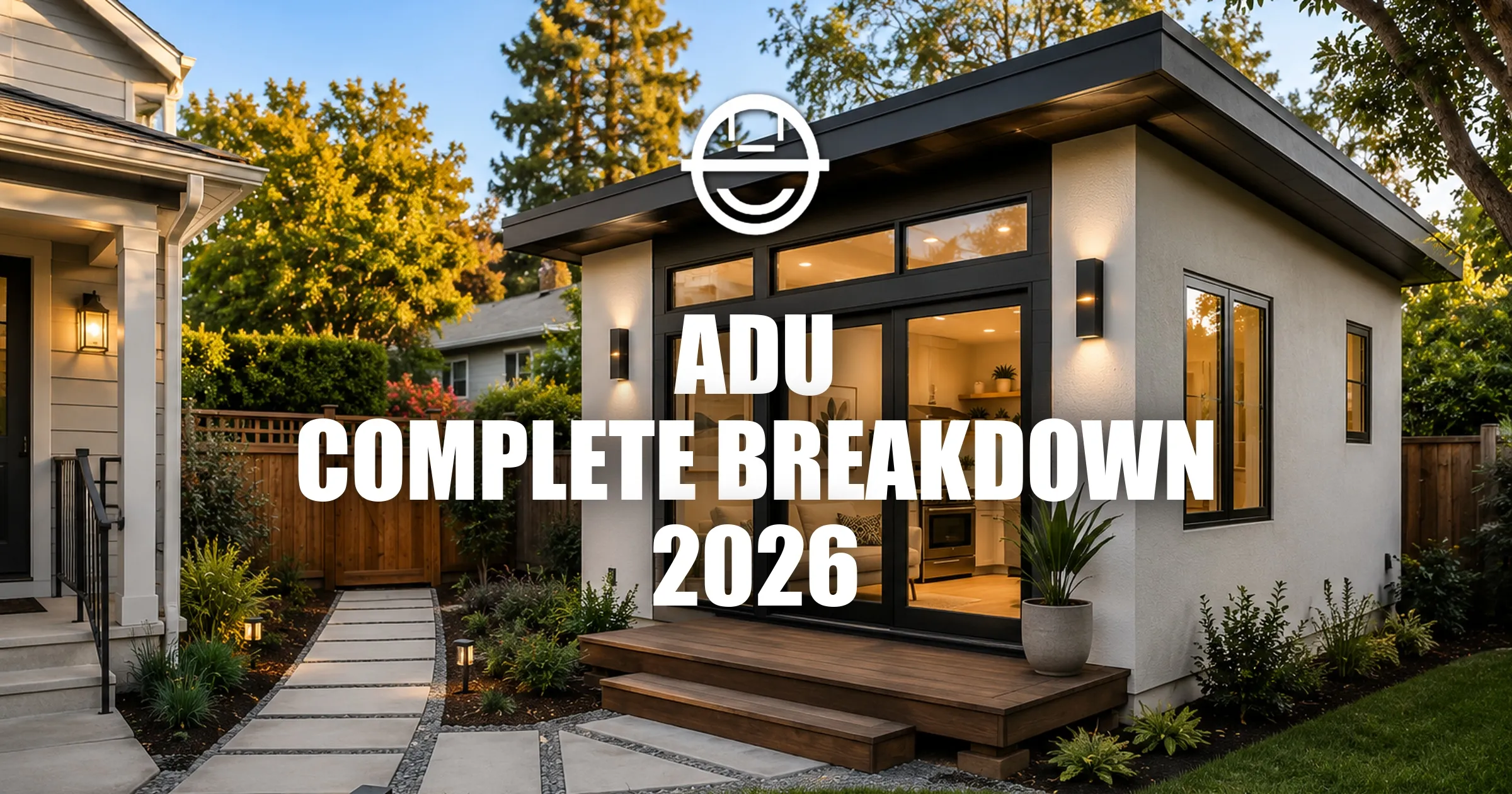
ADU Cost Guide 2026: Complete Breakdown by ADU Type, State, and Size — What Homeowners Actually Pay
Building an Accessory Dwelling Unit costs anywhere from $50,000 for a basic Junior ADU to $450,000+ for a custom detached unit — and the gap between those numbers comes down to three variables: what type you build, where you build it, and how large it is.
At a Glance: ADU Costs in 2026
|
|
|
|---|---|
|
Average cost |
$80,000 – $300,000 |
|
Cost per sq ft |
$150 – $600 (varies by state) |
|
ROI |
Rental income $1,200–$4,500/mo; adds $150K–$350K to property value |
|
Typical timeline |
4–12 months including permits |
|
Permit required |
Yes — in all states |
|
Local market factor |
Varies by state (see table below) |
ADU Cost by Type
The type of ADU you build is the single biggest cost driver — more than size, more than finishes.
|
ADU Type |
Cost Range |
Cost per Sq. Ft. |
Best for |
|---|---|---|---|
|
Junior ADU (JADU) |
$50,000 – $100,000 |
$150 – $350 |
Existing space inside home |
|
Garage conversion |
$80,000 – $150,000 |
$200 – $500 |
Attached or detached garage |
|
Attached ADU |
$100,000 – $250,000 |
$250 – $500 |
Addition to existing home |
|
Detached ADU (site-built) |
$150,000 – $450,000+ |
$300 – $600 |
New structure on same lot |
|
Prefab / modular ADU |
$100,000 – $220,000 |
$200 – $400 |
Faster build, less customization |
Junior ADU (JADU): $50,000 – $100,000
A JADU is built within the existing footprint of a single-family home — a converted bedroom, attached garage, or basement. Because it doesn't require new foundation or exterior framing, it's the lowest-cost ADU option. The tradeoff: size is capped at 500 sq ft under most state laws, and it must share at least one interior door with the main home.
Garage Conversion: $80,000 – $150,000
Converting an attached or detached garage adds significant value relative to cost because the structure already exists. The major costs are insulation, HVAC, electrical upgrade, plumbing rough-in, and finishing work. Garage conversions are the most common ADU type in California, where the majority of ADU permits have been pulled since 2020.
Detached ADU (Site-Built): $150,000 – $450,000+
A detached ADU is a fully independent structure with its own foundation, utilities, and entrance. It offers the most flexibility in design and the highest potential rental income — but also the highest cost and longest timeline (6–12 months is typical when permits are included). California detached ADUs in the Bay Area routinely exceed $400,000 for a 750 sq ft unit.

ADU Cost by Size
Size is the second major cost driver. These ranges reflect national averages — high-cost states (CA, WA) run 30–60% above these figures.
|
Size |
Unit Type |
National Cost Range |
Bay Area / LA Cost Range |
|---|---|---|---|
|
300 sq ft |
Studio |
$75,000 – $150,000 |
$120,000 – $250,000 |
|
500 sq ft |
1 Bedroom |
$125,000 – $250,000 |
$200,000 – $350,000 |
|
750 sq ft |
2 Bedroom |
$185,000 – $375,000 |
$300,000 – $500,000 |
|
1,000 sq ft |
2–3 Bedroom |
$250,000 – $500,000+ |
$400,000 – $650,000+ |
Cost per square foot typically decreases as size increases — the fixed costs (permits, utility connections, foundation work) get spread over more square footage. A 1,000 sq ft ADU doesn't cost twice as much as a 500 sq ft ADU; it costs roughly 1.6–1.8x.
ADU Cost by State
State laws, labor markets, and permitting systems create significant cost variation across the country.
|
State |
Cost per Sq. Ft. |
Typical Detached ADU |
Permitting Timeline |
ADU Law |
|---|---|---|---|---|
|
California |
$350 – $600 |
$175K – $450K+ |
3–6 months (varies by city) |
Most permissive in US — AB 68, SB 9 |
|
Oregon |
$200 – $350 |
$100K – $260K |
2–4 months |
HB 2001 — statewide ADU allowance |
|
Washington |
$200 – $400 |
$100K – $300K |
2–4 months |
Cities 10,000+ must allow ADUs |
|
Colorado |
$200 – $350 |
$100K – $250K |
2–4 months |
HB 1152 (2024) — statewide mandate |
|
Texas |
$100 – $250 |
$75K – $200K |
1–3 months |
No statewide law; city-by-city rules |
|
Florida |
$150 – $300 |
$80K – $225K |
2–4 months |
Growing but city-dependent |
California note: Since AB 68 (2020) eliminated most barriers to ADU permitting, California has led the country in ADU construction. State law now limits setbacks to 4 feet from rear and side property lines, prohibits owner-occupancy requirements for most ADUs, and caps impact fees for ADUs under 750 sq ft.
Texas note: Texas has no statewide ADU law, which means cities set their own rules. Austin has become one of the most ADU-friendly cities in the country. Houston has no zoning at all, which makes it uniquely permissive. Suburban Texas cities are more restrictive.
State ADU Law Snapshot
Understanding your state's ADU law determines what's possible before you spend a dollar on design.
California: The most permissive ADU state. No minimum lot size. Setbacks: 4 feet rear and sides. Allows ADUs and JADUs simultaneously on one lot. No owner-occupancy requirement (SB 9). Impact fees waived for ADUs under 750 sq ft.
Oregon: HB 2001 requires all cities and counties to allow ADUs in residential zones — the first statewide mandate of its kind. No minimum lot size for ADUs. Cities cannot require additional parking for ADUs near transit.
Washington: Cities with populations above 10,000 must permit ADUs. Seattle allows up to two ADUs per lot (one attached, one detached). No owner-occupancy requirement since 2019.
Colorado: HB 1152 (signed 2024) requires municipalities to allow ADUs statewide. Cities had until 2025 to update their codes. One of the most recent statewide ADU mandates — still being implemented in many cities.
Texas: City-by-city. Austin's HOME program (2023) allows ADUs on any residential lot with no minimum lot size. Houston: no zoning, so ADUs are generally permittable if they meet building code. Other Texas cities vary widely.
Hidden ADU Costs Homeowners Miss
The contract price for building an ADU doesn't include everything. These are the costs most homeowners don't account for upfront:
|
Hidden Cost |
Typical Range |
Notes |
|---|---|---|
|
Utility connection fees |
$5,000 – $25,000 |
Separate electrical meter, water, sewer lateral |
|
Architectural drawings |
$8,000 – $25,000 |
Required for permit submission in most cities |
|
Soils / geotechnical testing |
$1,000 – $5,000 |
Required on slopes or in earthquake zones |
|
Permit fees |
$8,000 – $30,000 |
Varies significantly by city |
|
School / impact fees |
$0 – $20,000 |
Waived for ADUs under 750 sq ft in CA; varies elsewhere |
|
Property tax increase |
$1,500 – $6,000/year |
ADU adds to assessed value; varies by state |
|
Temporary housing during construction |
$2,000 – $8,000 |
If you need to vacate during build |
|
Landscaping / hardscape restoration |
$2,000 – $10,000 |
Access routes, disturbed areas |
Budget 15–20% above the contractor quote to cover these items, especially if your property has older utilities or is in a seismic zone.
Prefab vs. Site-Built: Cost and Speed Comparison
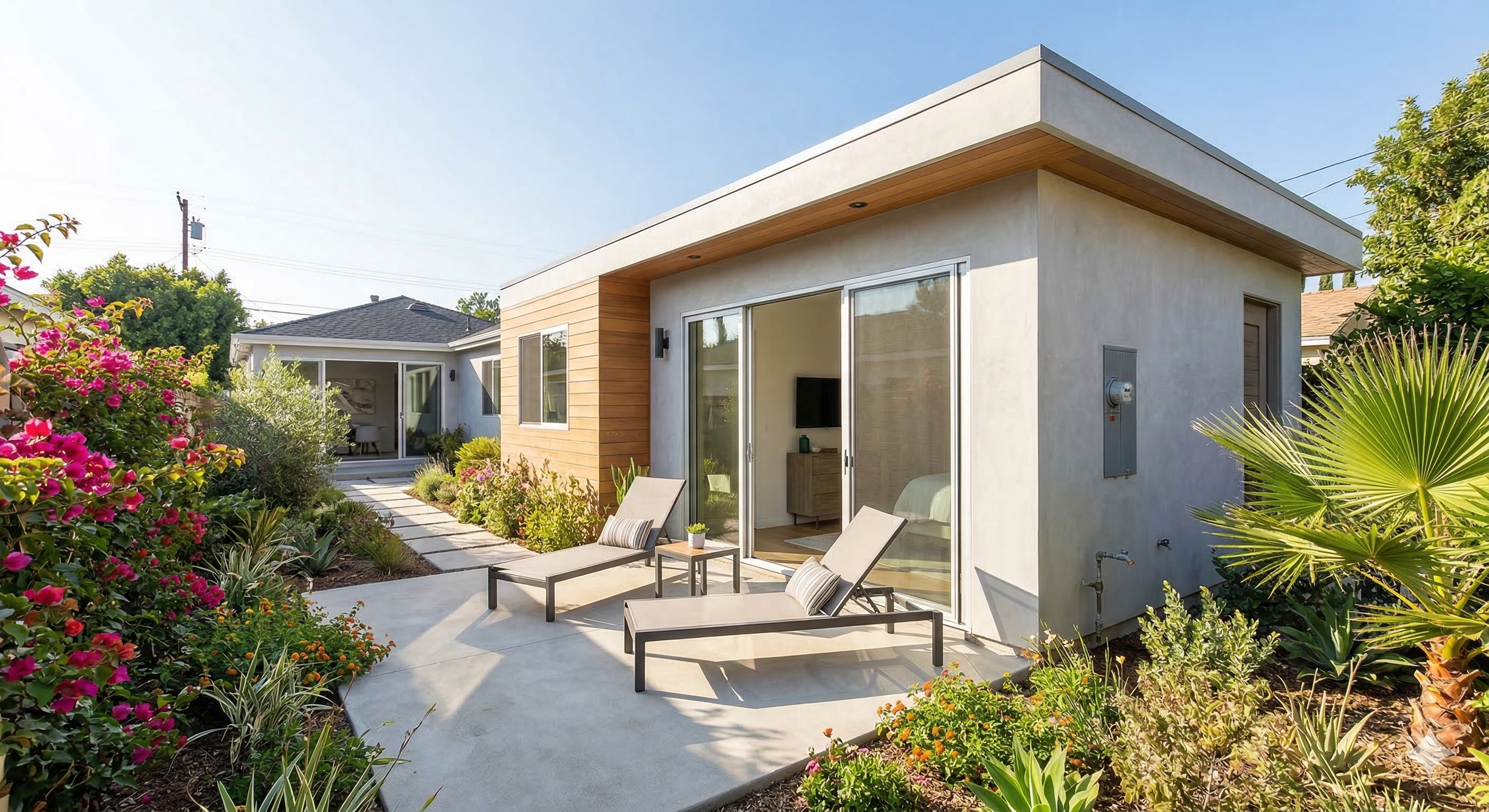
Prefabricated (modular) ADUs have become a genuine alternative to site-built in California and the Pacific Northwest, with manufacturers like Abodu, Mighty Buildings, and Cover delivering factory-built units.
|
|
Prefab / Modular |
Site-Built |
|---|---|---|
|
Cost per sq ft |
$200 – $400 |
$300 – $600 |
|
Construction timeline |
3–5 months total |
6–12 months total |
|
Customization |
Limited (standard floor plans) |
Full customization |
|
Local code compliance |
Varies — confirm with manufacturer |
Built to local code |
|
Financing |
Fewer lender options |
Standard construction loans |
|
Best for |
Speed, budget-constrained projects |
Maximum value, custom design |
Prefab is not always cheaper on a delivered-and-installed basis. Factor in site preparation, foundation work, utility connections, and permits — costs that apply regardless of whether the unit is prefab or stick-built.
ADU Rental Income Analysis
Rental income is the most common justification for ADU investment costs. Realistic monthly income by market:
|
Market |
Studio (300 sq ft) |
1BR (500 sq ft) |
2BR (750 sq ft) |
|---|---|---|---|
|
San Francisco / Bay Area |
$2,200 – $3,500 |
$3,000 – $4,500 |
$4,000 – $6,000 |
|
Los Angeles |
$1,800 – $2,800 |
$2,200 – $3,500 |
$3,000 – $4,500 |
|
Seattle |
$1,500 – $2,400 |
$1,800 – $2,800 |
$2,500 – $3,800 |
|
Austin |
$1,200 – $1,800 |
$1,500 – $2,200 |
$1,800 – $2,800 |
|
Denver |
$1,200 – $1,800 |
$1,500 – $2,000 |
$1,800 – $2,600 |
|
National average |
$1,000 – $1,600 |
$1,300 – $2,000 |
$1,600 – $2,500 |
Property value impact: A well-built ADU in a high-demand market typically adds $150,000–$350,000 to property value. The multiplier is roughly 100–120x monthly rent (e.g., a unit renting for $2,000/month in LA adds approximately $200,000–$240,000 to assessed market value).
ADU Financing Options
|
Option |
How it works |
Typical rate (2026) |
Best for |
|---|---|---|---|
|
HELOC |
Borrow against existing home equity |
Prime + 0.5–2% (~8–10%) |
Homeowners with significant equity |
|
Cash-out refinance |
Refinance mortgage at higher amount |
6.5–7.5% (30yr fixed) |
Homeowners with low existing rate — use carefully |
|
Construction-to-perm loan |
Converts to mortgage on completion |
7–8.5% |
New detached ADUs |
|
RenoFi / ADU-specific loans |
Lend on after-renovation value |
7–9% |
Limited equity situations |
|
State programs |
Grants or low-interest loans |
Varies (CA: CalHFA offers up to $40K grants) |
California homeowners — check CalHFA ADU Grant Program |
|
Personal / contractor financing |
Installment through builder |
Higher rates |
Prefab ADUs primarily |
California homeowners should check the CalHFA ADU Grant Program, which has offered up to $40,000 in pre-development cost grants for income-eligible households. Availability varies by funding cycle.
The Bottom Line
An ADU is most financially justified when the rental income covers the financing cost within 5–8 years — which is achievable in California, the Pacific Northwest, and other high-rent markets for detached units in the $200,000–$350,000 range. In lower-rent markets, the math is tighter: a $180,000 ADU in Austin generating $1,500/month takes roughly 10 years to recoup from rental income alone, but the property value increase often bridges the gap at sale.
For homeowners in states with recently passed ADU-friendly laws (Colorado, Oregon, Washington), 2026 is a window to build before the market becomes saturated with ADU inventory.
IA Remodelings connects homeowners with licensed ADU contractors who handle permit submissions, utility coordination, and construction timeline management — so your project doesn't stall waiting on paperwork that could have been filed in week one.
Want a specific estimate for your ADU in National?
Tell our agent about your project — it'll match you with a verified local pro in minutes.
.webp&w=3840&q=75)
Comments