
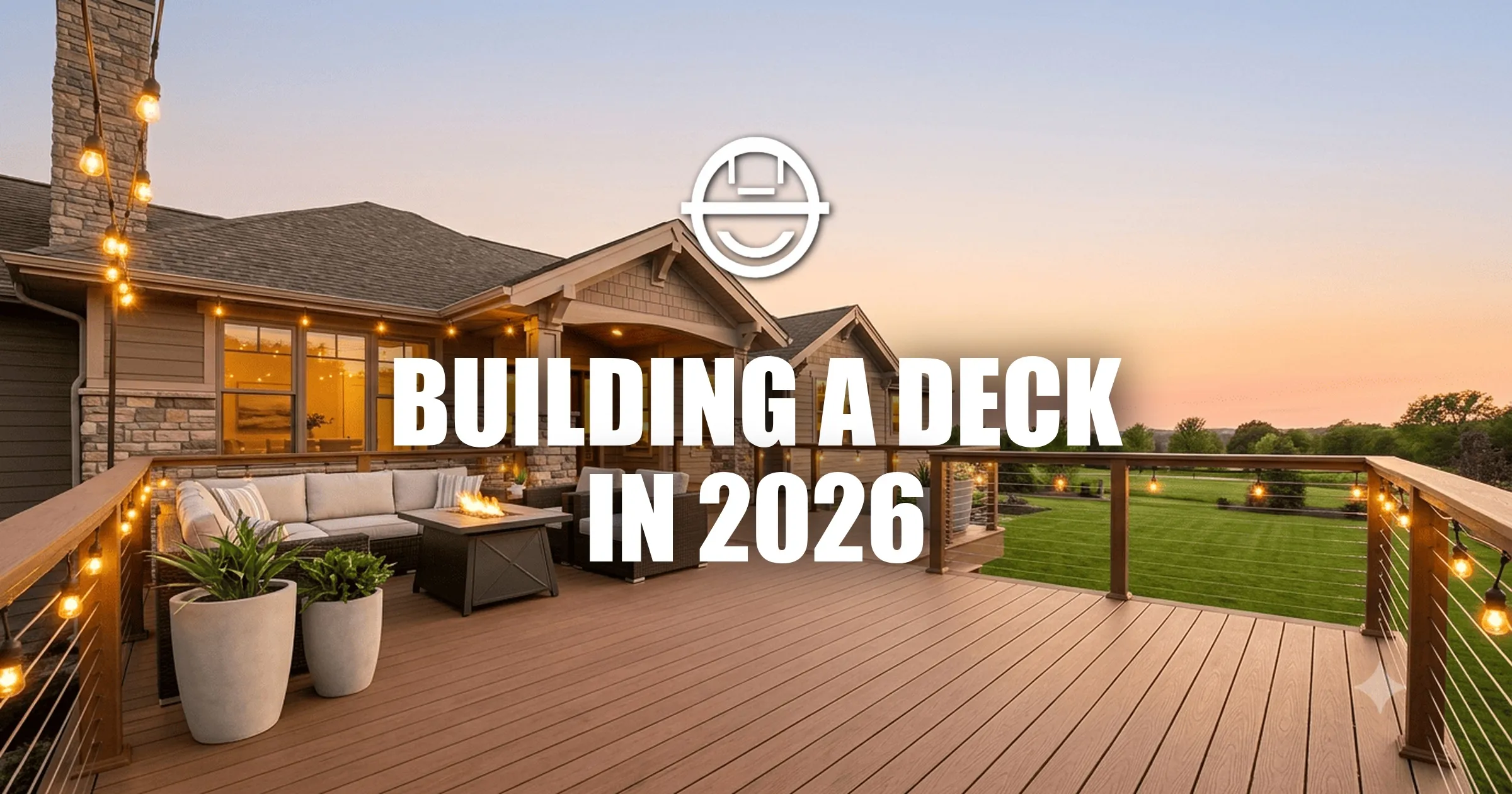
Building a Deck in 2026
How Much Does It Cost to Build a Deck in 2026?
The average cost to build a deck in 2026 is $30 to $60 per square foot installed, with most homeowners spending between $8,000 and $20,000 for a standard-sized deck. A modest 12×12 pressure-treated wood deck can start around $4,000–$7,000, while a large 20×20 composite deck with premium railings and features can reach $20,000–$30,000 or more.
The two biggest cost drivers are size and material. A simple ground-level pressure-treated pine deck is the most affordable option, while elevated multi-level decks built with composite or exotic hardwood sit at the top of the price range. Labor accounts for roughly 50–70% of the total project cost, making it the single largest expense.
Quick benchmark: The average American deck is 300–400 square feet. For a 320 sq ft (16×20) pressure-treated wood deck attached to a single-story home, budget approximately $8,000–$16,000. The same deck in composite runs $12,000–$24,000.
Deck Cost by Material
The decking material you choose determines not only the upfront price but also your maintenance commitment, lifespan, and long-term cost of ownership.
|
Material |
Material Cost (per sq ft) |
Installed Cost (per sq ft) |
Lifespan |
Maintenance |
|---|---|---|---|---|
|
Pressure-Treated Pine |
$2 – $5 |
$16 – $28 |
10–15 years |
High (stain/seal every 1–3 years) |
|
Cedar |
$4 – $8 |
$22 – $35 |
15–20 years |
Moderate (stain/seal every 2–4 years) |
|
Redwood |
$5 – $12 |
$27 – $38 |
20–30 years |
Moderate (periodic sealing) |
|
Composite (Trex, TimberTech) |
$5 – $13 |
$25 – $55 |
25–50 years |
Very low (occasional cleaning) |
|
PVC / Cellular |
$7 – $15 |
$30 – $60 |
25–50 years |
Very low |
|
Bamboo |
$3 – $10 |
$22 – $45 |
20–25 years |
Low–Moderate |
|
Ipe (Exotic Hardwood) |
$10 – $25 |
$35 – $65 |
40–75 years |
Low (optional oiling for color) |
|
Aluminum |
$15 – $20 |
$40 – $70 |
50+ years |
Almost none |
Pressure-Treated Wood
The most popular and affordable option in the United States. Pressure-treated pine is chemically treated to resist rot, decay, and insects, making it suitable for ground-contact and structural use. It's easy to work with and widely available.
The tradeoff is maintenance. Pressure-treated wood needs staining or sealing every 1–3 years to maintain its appearance and prevent graying, splitting, and warping. Even with proper care, it has the shortest lifespan of any common decking material. However, for homeowners on a tight budget, it delivers a functional outdoor space at the lowest upfront cost.
Cedar and Redwood
Natural softwoods that offer beautiful color and grain without chemical treatment. Cedar and redwood contain natural oils that resist insects and decay, though they still benefit from periodic sealing or staining. Cedar is more widely available and affordable; redwood is more durable but increasingly expensive due to limited supply.
Both materials are lighter and easier to work with than pressure-treated lumber, and they don't contain the chemicals found in treated wood. They're an excellent choice for homeowners who want a natural look with moderate maintenance.
Composite Decking
Composite decking — made from a blend of wood fibers and recycled plastic polymers — has become the fastest-growing segment of the decking market. Brands like Trex, TimberTech, and Fiberon offer products that closely mimic the look and feel of natural wood while requiring almost zero maintenance. No staining, no sealing, no sanding — just occasional cleaning with soap and water.
Composite costs more upfront than pressure-treated wood, but the lifetime cost often works out lower because you eliminate decades of staining, sealing, and potential board replacement. Most composite products carry 25–50 year warranties against structural defects, fading, and staining. The main downside: composite can retain more heat than wood in direct sunlight, making it uncomfortably hot underfoot in very sunny climates.
Exotic Hardwoods (Ipe, Tigerwood, Mahogany)
Exotic hardwoods are the premium tier of natural decking. Ipe, in particular, is legendary for its density, hardness, and natural resistance to rot, insects, fire, and UV damage. An Ipe deck can last 40–75 years with minimal maintenance. However, it's expensive, extremely heavy, and challenging to work with — requiring specialized tools and experienced installers.
Exotic hardwoods are best suited for homeowners who want the absolute best natural wood deck and are willing to invest accordingly.

Cost by Deck Size
Since decks are priced per square foot, size has a direct and predictable impact on cost. Here are estimates for common deck dimensions:
|
Deck Size |
Sq Ft |
Pressure-Treated Wood |
Composite |
Exotic Hardwood |
|---|---|---|---|---|
|
10×10 |
100 |
$1,600 – $2,800 |
$2,500 – $5,500 |
$3,500 – $6,500 |
|
12×12 |
144 |
$2,300 – $4,000 |
$3,600 – $7,900 |
$5,000 – $9,400 |
|
12×16 |
192 |
$3,100 – $5,400 |
$4,800 – $10,600 |
$6,700 – $12,500 |
|
16×20 |
320 |
$5,100 – $9,000 |
$8,000 – $17,600 |
$11,200 – $20,800 |
|
20×20 |
400 |
$6,400 – $11,200 |
$10,000 – $22,000 |
$14,000 – $26,000 |
|
20×24 |
480 |
$7,700 – $13,400 |
$12,000 – $26,400 |
$16,800 – $31,200 |
Cost by Deck Type
The style and elevation of your deck significantly affect construction complexity — and cost:
Ground-Level / Platform Deck: $15 – $30 per sq ft
The simplest and most affordable option. Built close to the ground (under 30 inches), these decks often don't require railings (depending on local codes). They function similarly to a patio but with the warmth and flexibility of wood or composite. Minimal structural framing keeps labor costs low.
Attached Elevated Deck: $30 – $50 per sq ft
The most common residential deck type. Attached to the home at the first-floor level, elevated 3–8 feet above ground with stairs and railings. Requires concrete footers, structural posts, and proper ledger board attachment to the house. This is the standard deck most homeowners envision.
Second-Story Deck: $45 – $65+ per sq ft
Built at second-floor level, requiring tall structural posts, reinforced foundations, and more complex engineering. Costs increase due to additional materials, safety equipment, and labor hours. The upside: a second-story deck creates a covered patio or storage space underneath.
Multi-Level Deck: $50 – $100 per sq ft
Two or more connected deck platforms at different elevations, often incorporating stairs, built-in seating, planters, or transitions between levels. These designs maximize usable space on sloped lots and create distinct zones for cooking, dining, and lounging. Complex designs with premium materials push costs toward the upper end.
Wrap-Around Deck: $35 – $65 per sq ft
Extends along two or more sides of the home, offering multiple access points and panoramic views. Requires more materials and longer build times than a single-face deck. Popular for homes with scenic lots or those wanting to maximize outdoor living space.
Where Your Deck Budget Goes
Decking and materials: 30–50%
The deck boards themselves, plus framing lumber, hardware (joist hangers, screws, bolts), concrete for footers, flashing, and any underlayment or joist protection tape. Material grade is the biggest variable — switching from pressure-treated pine to composite can double or triple material costs.
Labor: 50–70%
Professional deck labor runs $15–$35 per square foot nationally. Rates increase for elevated decks, complex designs, difficult site access, and regions with high labor costs. Labor is the majority of most deck budgets, and it's where hiring experienced builders delivers the biggest return in quality and longevity.
Railings: 5–15%
Railing systems range from $15–$30 per linear foot for pressure-treated wood to $50–$100+ for cable, glass, or composite systems. For a 320 sq ft deck with roughly 60 linear feet of railing, that's $900–$6,000. Railings have an outsized impact on the deck's finished appearance.
Stairs: 3–8%
Stairs cost $50–$150 per step, depending on material and width. A standard 4-step staircase runs $200–$600; a long staircase to a second-story deck can cost $1,500–$3,000+.
Permits: 1–3%
Most jurisdictions require permits for new deck construction. Fees range from $225 to $500. Your contractor should handle the permit application and any required inspections.
Extras and features: Variable
Built-in benches ($200–$2,000), pergolas ($2,000–$8,000), outdoor lighting ($500–$3,000), fire pits ($200–$2,000), deck skirting ($500–$2,000), and privacy screens ($300–$3,000) all add function and appeal but increase the total investment.

Return on Investment: Is a Deck Worth Building?
A deck consistently ranks among the most enjoyable and highest-ROI home improvement projects. According to the National Association of Realtors, homeowners who added a new wood deck recovered approximately 89% of the cost through increased home value — and rated the project a 9.8 out of 10 on a "joy score."
Composite decks return around 40–50% of project cost at resale. The lower percentage doesn't mean composite is a bad investment — it reflects the higher upfront cost relative to the incremental value buyers assign. In practical terms, a $15,000 composite deck that adds $7,500 in home value also delivers 25–50 years of maintenance-free outdoor living, which has real quality-of-life value that ROI calculations don't capture.
The bottom line: almost no homeowner regrets building a deck. The combination of added living space, entertainment value, curb appeal, and resale contribution makes it one of the most satisfying home improvements available.
Wood vs. Composite: Which Should You Choose?
This is the most common decision homeowners face. Here's a straightforward comparison:
|
Factor |
Pressure-Treated Wood |
Composite |
|---|---|---|
|
Upfront cost |
Lower ($16–$28/sq ft) |
Higher ($25–$55/sq ft) |
|
Maintenance |
High (stain/seal every 1–3 years) |
Very low (wash occasionally) |
|
Lifespan |
10–15 years |
25–50 years |
|
Appearance |
Natural wood grain; grays over time |
Mimics wood; color is consistent and permanent |
|
Heat retention |
Cooler underfoot in sun |
Can get hot in direct sunlight |
|
Eco-friendliness |
Chemical treatment; shorter life |
Made from recycled materials; longer life |
|
Lifetime cost (20 years) |
Higher (stain + board replacement) |
Lower (no maintenance + longer life) |
|
ROI at resale |
~52–89% |
~40–50% |
Choose wood if: Budget is the primary concern, you enjoy hands-on maintenance, or you want the authentic feel and cooler surface temperature of natural wood.
Choose composite if: You want a "set it and forget it" deck, plan to keep the home long-term, prefer consistent appearance over decades, or want to avoid the recurring cost and effort of staining and sealing.
How to Budget and Plan Your Deck Project
1. Define how you'll use the space. Cooking and dining require more square footage than a simple lounging area. If you're adding a grill, outdoor kitchen, hot tub, or fire pit, plan the layout around these features from the start — retrofitting is expensive.
2. Choose your material. Balance your budget, maintenance tolerance, and how long you plan to stay in the home. If you're selling within 5 years, a clean pressure-treated deck offers the best cost-to-ROI ratio. If you're staying 15+ years, composite pays for itself through eliminated maintenance.
3. Decide on size and type. Most contractors recommend a deck that's no more than 20% of your home's square footage. A 2,000 sq ft home pairs well with a 300–400 sq ft deck. Consider whether ground-level, elevated, or multi-level suits your property and lifestyle.
4. Get three or more written estimates. Ensure each quote includes the same scope: footers, framing, decking, railings, stairs, hardware, permits, and cleanup. Ask about material warranties and workmanship guarantees.
5. Verify contractor credentials. Check licensing, insurance, and recent deck-building experience. Ask for photos and references from completed projects similar to yours. Manufacturer certifications (Trex Pro, TimberTech Pro) indicate specialized training for composite installations.
6. Plan for timing. Spring and summer are peak deck-building season, which means longer wait times and potentially higher prices. Booking in late winter or early spring secures your spot on the contractor's schedule. In mild climates, fall and winter builds can offer better pricing.
7. Budget for extras. Lighting, privacy screens, built-in seating, and landscaping around the deck all add to the finished experience. Budget these as separate line items so you can add them during construction or phase them in later.
Want a specific estimate for your decks in National?
Tell our agent about your project — it'll match you with a verified local pro in minutes.
.webp&w=3840&q=75)
Comments