
Complete Window Replacement Cost Guide 2026: Every Window Type, Energy Savings, and When It Is Worth It
Window replacement sits at the intersection of comfort, energy bills, and resale value — which makes the cost decision more layered than most remodeling projects. The right window for a 1960s ranch home in Minnesota is different from the right window for a 2000s colonial in Georgia, and the difference in cost and energy return between those choices is significant. This guide covers what each window type actually costs, how to choose between insert and full-frame replacement, what the energy savings data actually shows, and what returns to expect at resale.
At a Glance: Window Replacement Costs 2026
|
|
|
|---|---|
|
National cost range |
$450 – $2,500+ per window |
|
Typical full-house cost |
$10,000 – $30,000 (15–20 windows) |
|
ROI at resale (vinyl) |
~68% per Cost vs. Value Report 2025 |
|
Energy savings |
10–25% reduction on heating/cooling bills |
|
IRS Section 25C tax credit |
Up to $600/year for windows and skylights |
|
Typical timeline |
1–3 days for full-house replacement |
|
Permit required |
Yes for structural changes; varies by jurisdiction for like-for-like |
|
Market factor |
1.00x (national baseline) |
How Much Does Window Replacement Cost in 2026?
The cost of window replacement depends on three primary variables: window type (double-hung, casement, bay, etc.), frame material (vinyl, fiberglass, wood), and whether you're doing an insert replacement or a full-frame replacement. Labor accounts for 30–50% of total project cost and varies by accessibility, number of stories, and disposal requirements.
Quick benchmark: A standard double-hung vinyl window replacement (insert, existing frame in good condition) runs $450–$850 per window installed nationally. A 15-window home replaced with mid-range vinyl costs $8,000–$15,000. The same home with fiberglass windows runs $15,000–$28,000.
Window Type Cost Breakdown
|
Window type |
Installed cost range |
Notes |
|---|---|---|
|
Double-hung (vinyl) |
$450 – $850 |
Most common residential type; both sashes tilt for cleaning |
|
Single-hung (vinyl) |
$375 – $700 |
Lower sash moves only; slightly less expensive |
|
Casement (fiberglass/vinyl) |
$550 – $1,400 |
Crank-operated; excellent air seal when closed |
|
Sliding (vinyl) |
$400 – $900 |
Good for wide openings; easier to operate than double-hung |
|
Picture (fixed) |
$300 – $800 |
No moving parts; maximizes glass area; no ventilation |
|
Awning (vinyl/fiberglass) |
$500 – $1,100 |
Hinged at top; opens outward; good for rain ventilation |
|
Bay window |
$1,800 – $6,000 |
Three-unit composite; adds floor space and light; complex install |
|
Bow window |
$2,500 – $6,000 |
Four or more units in an arc; premium labor cost |
|
Garden window |
$1,000 – $4,000 |
Projects outward; heated growing space; complex install |
|
Egress (basement) |
$1,000 – $5,000 |
Includes well excavation; code-required for habitable basements |
Specialty shapes (arched, circular, trapezoid) add 20–40% to the base window cost due to custom manufacturing and non-standard installation.
Frame Material: What Each One Costs and Delivers
|
Frame material |
Cost per window |
Lifespan |
Maintenance |
Best for |
|---|---|---|---|---|
|
Vinyl |
$250 – $550 |
20–40 years |
None (no painting) |
Most residential applications |
|
Fiberglass |
$400 – $900 |
30–50+ years |
Minimal |
High-performance, extreme climates |
|
Wood |
$500 – $1,200 |
20–30 years (with maintenance) |
High (painting, sealing) |
Historic homes, interior aesthetics |
|
Aluminum |
$200 – $450 |
20–30 years |
Low |
Commercial, modern design |
|
Composite |
$300 – $700 |
25–40 years |
Low |
Budget alternative to fiberglass |
Vinyl dominates the residential replacement market because it combines low cost, zero maintenance, and adequate insulation. Fiberglass is 50–100% more expensive than vinyl but has higher strength-to-weight ratio, better dimensional stability (doesn't expand and contract as much with temperature), and longer lifespan — worth the premium in extreme climates or for premium homes. Wood is the most expensive to maintain over time; most homeowners who want a wood look choose wood-clad windows (fiberglass or aluminum exterior, wood interior) to get the aesthetic without the exterior maintenance burden.
Glass Package Options
The glass package affects both the upfront cost and the ongoing energy performance of the window:
|
Glass option |
Added cost per window |
What it does |
|---|---|---|
|
Double-pane (standard) |
Baseline |
Two panes with air or gas fill; standard insulation |
|
Triple-pane |
+$80 – $200 |
Third pane; higher insulation; adds weight |
|
Low-E coating |
+$30 – $80 |
Reflects infrared heat; reduces UV fading |
|
Argon gas fill |
+$25 – $75 |
Denser than air; improves insulation between panes |
|
Krypton gas fill |
+$50 – $150 |
Better than argon; used in triple-pane |
|
Tempered glass |
+$50 – $120 |
Safety requirement near doors, stairs, wet areas |
|
Impact-resistant (laminated) |
+$150 – $400 |
Hurricane zones; also reduces noise and UV |
ENERGY STAR certified windows meet minimum U-factor and Solar Heat Gain Coefficient (SHGC) thresholds by climate zone. In cold climates (Climate Zones 4-7), the priority is a low U-factor (heat retention); in hot climates (Climate Zones 1-3), the priority is a low SHGC (solar heat rejection). The same window that's efficient in Minneapolis is the wrong choice for Phoenix.
Insert vs. Full-Frame Replacement: The Decision That Affects Everything
This is the most consequential cost decision in a window replacement project:
Insert replacement (pocket replacement): the new window unit is installed into the existing frame, which stays in place. Faster, less invasive, and 20–40% less expensive than full-frame. Requires that the existing frame is structurally sound, plumb, level, and square — and that there's no rot, water damage, or mold behind the casing.
Full-frame replacement: the entire window assembly — frame, sill, casing, and all — is removed down to the rough opening and replaced from scratch. More expensive and more disruptive, but allows for a perfect air seal, addresses any rot or damage discovered during removal, and can resize or relocate the opening.
|
Factor |
Insert replacement |
Full-frame replacement |
|---|---|---|
|
Typical added cost vs. insert |
— |
+30–50% per window |
|
When to use |
Frame is solid, no rot, standard size |
Frame is damaged, rotted, or out of square |
|
Air seal quality |
Good (depends on frame condition) |
Best possible |
|
Disruption |
Minimal (no interior or exterior finishing) |
Significant (drywall, trim, exterior work) |
|
Addresses water damage |
No |
Yes |
The decision isn't purely aesthetic or preference — if there's rot or water intrusion behind the frame, an insert replacement will seal the problem in rather than fixing it. A good contractor will pull back a section of interior trim to inspect the frame condition before recommending insert vs. full-frame.
What Drives Labor Costs
Labor accounts for 30–50% of total window replacement cost. The variables that push labor higher:
Number of stories: second-floor windows require ladders or scaffolding. Third-floor or higher requires scaffolding in most cases. Labor rates for upper-floor windows typically run 25–50% higher than ground floor.
Window accessibility: windows above stairs, over built-in furniture, or in tight spaces take longer to install. Bay and bow windows require additional structural support and are charged as specialty installations.
Insert vs. full-frame: full-frame replacements require removal of interior trim, exterior casing, and sometimes drywall patching — all of which add labor time after the window itself is installed.
Disposal fees: most contractors include haul-away of old windows in their quote, but it's worth confirming. Disposal of old windows with lead paint (common in pre-1978 homes) requires special handling and may be charged separately.
Regional labor market: labor rates nationally range from $35–$65/hour for window installers. In high-cost metros (New York, San Francisco, Seattle, Boston), rates run $65–$100/hour.
Energy Savings and IRS Section 25C Tax Credits
ENERGY STAR certified windows reduce energy consumption by 10–25% on heating and cooling bills compared to single-pane windows. The actual savings depend on:
- Climate zone: homes in extreme climates (very cold or very hot) see larger absolute savings
- Existing window condition: replacing single-pane aluminum windows saves more than replacing 15-year-old double-pane vinyl
- Home insulation: if the walls and attic are poorly insulated, window replacement alone won't dramatically change heating bills
- Glass package: triple-pane with Low-E and argon maximizes savings but has a longer payback period due to higher upfront cost
IRS Section 25C Energy Efficient Home Improvement Credit: homeowners can claim 30% of the cost of qualifying window replacements, up to a $600 annual maximum for windows and skylights combined (separate from the $600 limit for doors). To qualify, windows must meet ENERGY STAR Most Efficient certification criteria for their climate zone. The credit is non-refundable — it reduces tax owed, not a cash refund. Consult a tax professional to confirm eligibility for your specific project.
ROI at Resale: What the Data Shows
The Cost vs. Value Report 2025 tracks window replacement ROI nationally:
|
Project |
Average national cost |
Value recouped |
ROI |
|---|---|---|---|
|
Vinyl window replacement (10 windows) |
~$17,700 |
~$12,000 |
~68% |
|
Wood window replacement (10 windows) |
~$23,200 |
~$14,300 |
~62% |
Window replacement doesn't return dollar-for-dollar at resale, but it removes a significant buyer objection — drafty, fogged, or damaged windows generate repair credit requests in nearly every home inspection. A home with recently replaced windows also photographs and shows better, which matters in a competitive listing.
The energy savings argument for window replacement is real but long-horizon: at $200–$400/year in reduced energy bills, the payback period on a $15,000 vinyl window replacement project is 38–75 years on energy savings alone. The ROI case is primarily about buyer confidence, comfort, and inspection report cleanliness, not energy payback.
Signs It's Time to Replace, Not Repair
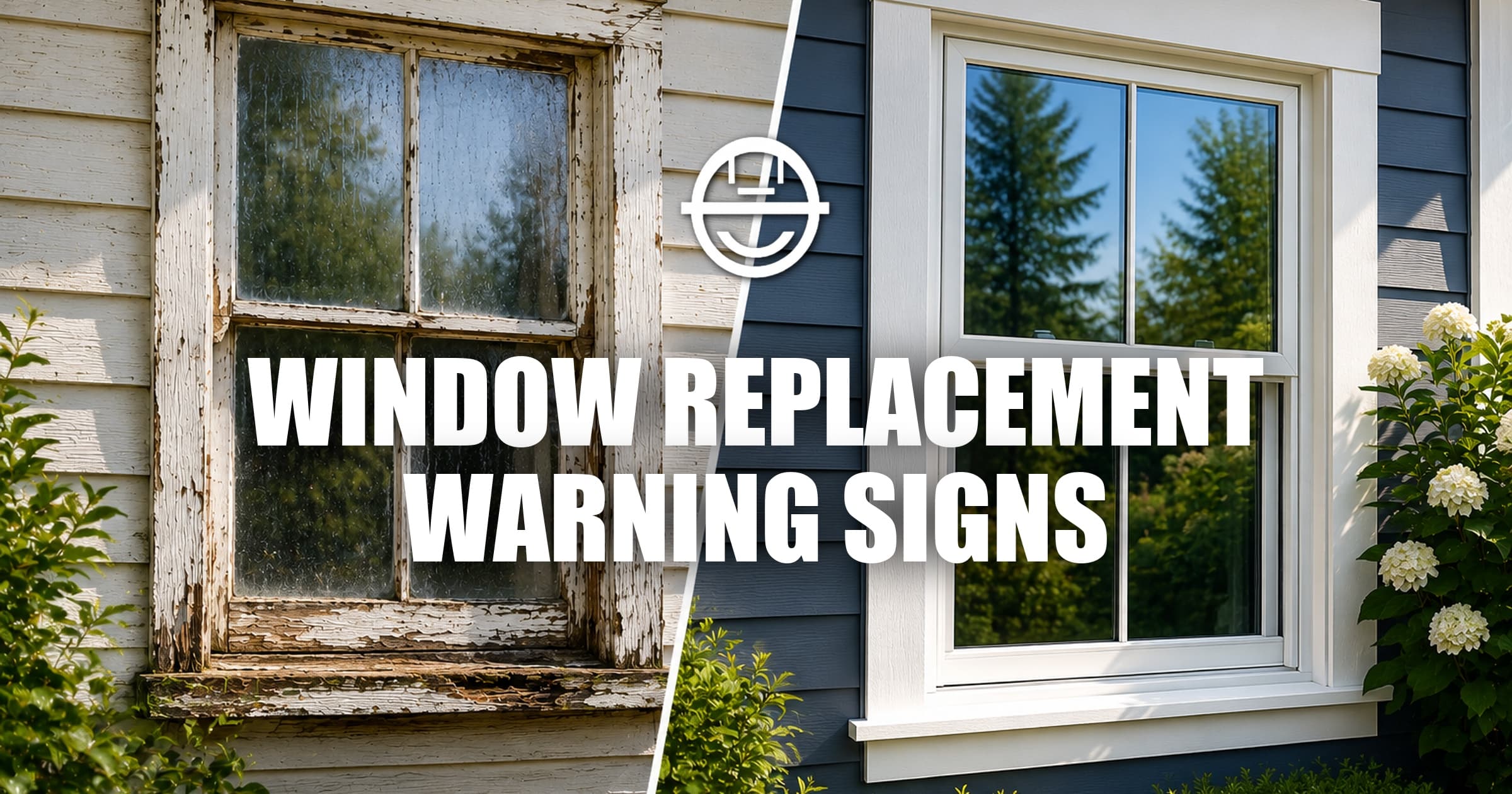
- Condensation between panes: fog or water between the glass panes means the seal has failed. This cannot be repaired — the glass unit must be replaced. If the frame is in good condition, a glass-only replacement is sometimes possible and cheaper.
- Drafts with windows closed: air infiltration around a closed window indicates frame failure, failed weatherstripping, or failed caulking. Weatherstripping replacement is worth trying first; if the problem persists, the frame has warped or deteriorated.
- Difficulty operating: windows that stick, won't stay open, or won't close fully have either hardware failure (often repairable) or frame damage from moisture (usually warrants replacement).
- Visible rot or soft spots in the frame: press the wood frame with a screwdriver. If it gives, there's rot. Rot spreads and can affect the structural integrity of the rough opening — address it before it requires structural repair.
- Fogged or stained glass that won't clean: interior staining of double-pane glass is a seal failure. Exterior staining is usually mineral deposit, cleanable with specialized products.
- Single-pane windows in an extreme climate: single-pane windows in Climate Zones 5-7 (Midwest, Northeast, Mountain) are the highest-ROI replacement scenario — the energy savings are large enough that replacement is almost always financially justified within a reasonable timeframe.
Want a specific estimate for your windows in National?
Tell our agent about your project — it'll match you with a verified local pro in minutes.


Comments