
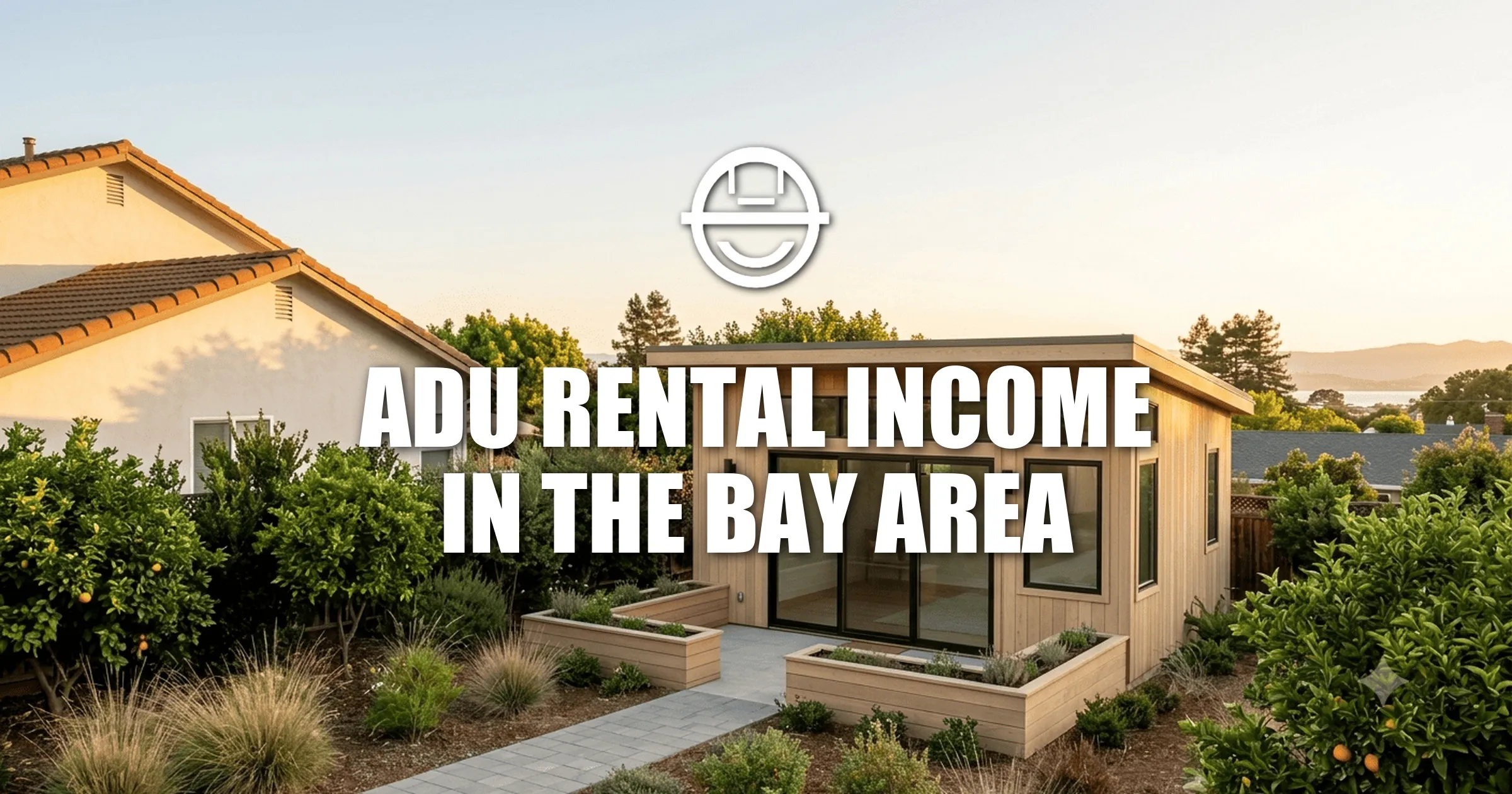
ADU Rental Income in the Bay Area: What You Will Actually Earn in 2026 (By City)
Bay Area homeowners building ADUs are generating $1,800 to $4,500 per month in rental income — but actual numbers vary sharply by city, unit type, and what you spend to build. This guide breaks down realistic income expectations city by city, construction costs by ADU type, permit timelines, and how to calculate whether the numbers work before you commit to a project.
At a Glance: ADU in the Bay Area 2026
|
|
|
|---|---|
|
Average build cost |
$80,000 – $150,000 (garage conversion) · $150,000 – $450,000+ (detached) |
|
Cost per sq ft |
$350 – $650 |
|
Rental income range |
$1,800 – $4,500/mo depending on city and size |
|
Property value added |
$150,000 – $400,000 depending on unit and location |
|
Typical build timeline |
4–12 months including permits |
|
Permit required |
Yes — required for all ADU types |
|
Bay Area cost multiplier |
~1.35 – 1.45x national baseline |
Quick benchmark: A garage conversion ADU in Oakland can generate $2,400–$3,200 per month in rental income on a total investment of $90,000–$160,000 — one of the strongest return profiles of any Bay Area home improvement.
How Much Does an ADU Cost in the Bay Area in 2026?
The cost of building an ADU in the Bay Area runs 35–45% above national averages, driven by Bay Area labor rates, permit fees, and material costs. Here are typical cost ranges by ADU type at Bay Area prices:
|
ADU type |
Bay Area cost range |
Best for |
|---|---|---|
|
Junior ADU (JADU) — interior conversion |
$50,000 – $110,000 |
Lowest cost entry; uses existing square footage |
|
Garage conversion |
$90,000 – $160,000 |
Best ROI; eliminates foundation and framing costs |
|
Attached ADU addition |
$175,000 – $325,000 |
Adds sq ft to home footprint; higher permit complexity |
|
Detached ADU — prefab / modular |
$160,000 – $280,000 |
Faster timeline; limited by lot size and setbacks |
|
Detached ADU — custom build |
$280,000 – $500,000+ |
Full design flexibility; highest cost and longest timeline |
Line-item breakdown for a garage conversion ADU ($90k–$160k range)
|
Cost component |
Typical range |
|---|---|
|
Demo and site prep |
$3,000 – $8,000 |
|
Framing and insulation |
$10,000 – $20,000 |
|
Electrical (new panel or sub-panel) |
$8,000 – $18,000 |
|
Plumbing (kitchen + bathroom rough-in) |
$12,000 – $22,000 |
|
HVAC (mini-split system) |
$5,000 – $10,000 |
|
Drywall, paint, flooring |
$10,000 – $18,000 |
|
Kitchen and bathroom finishes |
$15,000 – $30,000 |
|
Windows and exterior door |
$5,000 – $12,000 |
|
Permits and plan check |
$10,000 – $22,000 |
|
Total |
$78,000 – $160,000 |
Permit fees are the most variable line item — San Francisco permit costs run 2–3x higher than Oakland for the same scope.
Rental Income by Bay Area City
Rental income from an ADU varies significantly across Bay Area cities, driven primarily by local market rents, proximity to employment centers, and transit access:
|
City / area |
1-BD ADU / mo |
2-BD ADU / mo |
Notes |
|---|---|---|---|
|
San Francisco |
$2,800 – $3,800 |
$3,800 – $5,200 |
Highest rents; also highest permit cost and timeline |
|
Peninsula (Palo Alto, Menlo Park) |
$2,800 – $3,800 |
$3,600 – $5,000 |
Tech-adjacent demand; premium for transit-walkable locations |
|
Marin County |
$2,400 – $3,200 |
$3,000 – $4,200 |
Limited ADU supply drives rents up; longer permit timelines |
|
San Jose |
$2,000 – $2,800 |
$2,600 – $3,600 |
Large renter population; high demand for smaller units |
|
Oakland |
$1,900 – $2,700 |
$2,500 – $3,400 |
Strong demand; most favorable permit timeline in the region |
|
East Bay suburbs (Fremont, Hayward) |
$1,800 – $2,400 |
$2,200 – $3,000 |
Lower rents but lower build costs; solid middle-ground ROI |
What drives rent at the unit level: separate entrance (adds $150–$300/mo vs shared entry), in-unit laundry (adds $100–$200/mo), EV charging in the South Bay (increasingly expected), dedicated parking space (adds $100–$250/mo in most Bay Area cities).
The Break-Even Calculation
To evaluate whether an ADU investment makes sense, you need net operating income — not just gross rent:
Example: $130,000 garage conversion in Oakland, 1-bedroom unit
|
|
Monthly |
Annual |
|---|---|---|
|
Gross rent |
$2,500 |
$30,000 |
|
Vacancy allowance (5%) |
–$125 |
–$1,500 |
|
Property tax increase (partial reassessment) |
–$115 |
–$1,380 |
|
Insurance addition |
–$60 |
–$720 |
|
Maintenance reserve (1% of ADU cost/yr) |
–$108 |
–$1,300 |
|
Net operating income |
$2,092 |
$25,100 |
Return on investment: $25,100 / $130,000 = 19.3% annuallyCash-on-cash payback period: ~5.2 years
This calculation assumes no mortgage on the ADU construction. Homeowners using a HELOC or construction loan should subtract their annual debt service to get true cash-on-cash return.
Property value impact: Bay Area appraisers generally capitalize ADU income at a 5–6% rate. At $25,100 annual NOI, that implies $418,000–$500,000 in added value for a unit that cost $130,000 to build — though actual value added in a sale depends on comparable sales in your specific neighborhood.
Bay Area ADU Permit Timeline by City
Permit timelines are the most commonly underestimated variable in ADU projects. Plan the permit timeline before committing to a contractor start date:
|
City |
Permit timeline |
Notes |
|---|---|---|
|
Oakland |
3–6 months |
Fastest in the region; streamlined ADU process |
|
San Jose |
4–8 months |
Pre-approved standard plans can reduce timeline by 2–3 months |
|
Fremont / East Bay suburbs |
4–8 months |
Generally efficient; some cities have ADU pre-approval programs |
|
San Francisco |
8–18 months |
Most complex process; plan check backlog; historic review in many neighborhoods |
|
Marin County |
8–16 months |
Varies widely by jurisdiction; some unincorporated areas are slower |
Practical implication: If your project is in San Francisco and you're planning rental income to service a HELOC, budget for 12+ months before the unit is tenant-ready. Oakland or San Jose with pre-approved plans can have a tenant in place in 12–18 months from project start.
What ADU Tenants in the Bay Area Want
Bay Area renters for ADU units are typically working professionals, young families, or graduate students. Features that meaningfully affect both rental rate and vacancy:
- Separate private entrance — non-negotiable for most tenants; shared entry reduces the tenant pool significantly
- In-unit washer/dryer — adds $100–$200/mo and reduces vacancy; shared laundry is a consistent friction point for Bay Area renters
- Dedicated high-speed internet infrastructure — important across the region, critical in tech-heavy South Bay
- EV charging outlet (NEMA 14-50 or Level 2 charger) — increasingly expected in San Jose, Palo Alto, and Cupertino; commands a premium
- Dedicated parking — worth $100–$250/mo in most Bay Area cities; less important near BART stations
What doesn't move the needle: elaborate finishes. Bay Area ADU tenants prioritize function and location over premium countertops or designer tile. Mid-range finishes and excellent systems (HVAC, insulation, soundproofing) outperform luxury surfaces in tenant satisfaction and retention.
How to Finance an ADU in the Bay Area
|
Option |
How it works |
Best for |
|---|---|---|
|
HELOC |
Draw against existing home equity; interest-only payments during build |
Homeowners with significant equity; low upfront cost |
|
Cash-out refinance |
Replace existing mortgage at higher amount |
If current rate is already high; locks in a fixed rate |
|
Construction loan |
Short-term loan for the build; converts to permanent mortgage |
New buyers or limited equity |
|
CalHFA ADU Grant |
Up to $40,000 grant for qualifying households |
Income-qualified homeowners; check eligibility at calhfa.ca.gov |
|
Bay Area PACE financing |
Property-assessed financing; repaid through property tax bill |
Homeowners who want no upfront cash; higher long-term cost |
CalHFA's ADU grant program has income limits and requires use of approved contractors — verify current program availability and eligibility requirements directly with CalHFA before counting on this funding.
Risks and What Homeowners Get Wrong
The most common mistakes that turn a sound ADU investment into a costly one:
Permit timeline optimism. Homeowners consistently underestimate how long permits take, especially in San Francisco and Marin. A 6-month delay in a 12-month project doubles the carrying cost of any construction financing.
Construction cost overruns. Get three written bids with line-item scopes before signing a contract. A bid without detailed scope is a budget with no ceiling. Bay Area contractor availability means the cheapest bid isn't always the fastest — evaluate both price and schedule.
Occupancy rate assumptions. A 5% vacancy allowance is realistic for established Bay Area markets. Assuming 100% occupancy from month one overstates return and understates the payback period.
Property tax reassessment. In California, ADU construction triggers a partial reassessment — only the value added by the ADU is reassessed, not the entire property (AB 1482 protections). Estimate an additional $1,000–$2,000/year in property taxes for a typical garage conversion ADU.
Setback and zoning assumptions. State law (AB 68, AB 2221) significantly liberalized ADU rules in California, but city-specific setback, height, and lot coverage requirements still apply. Verify your specific parcel's constraints before engaging a contractor or designer.
Want a specific estimate for your ADU in Bay Area?
Tell our agent about your project — it'll match you with a verified local pro in minutes.

Comments