
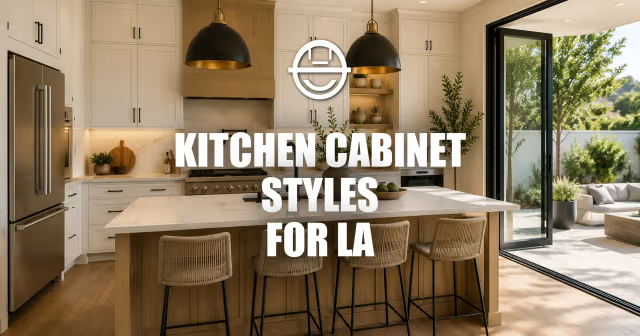
Kitchen Cabinet Styles for LA Homes: What is Trending, What Lasts, and What to Avoid in 2026
Cabinet choices drive more of your kitchen remodel budget — and more of its resale impact — than any other single decision. In LA, labor costs run approximately 1.35x the national baseline, which means cabinet upgrades that feel modest in cost nationally land at $50,000–$80,000+ locally for a full kitchen. Choosing the right style, material, and cabinet tier isn't just an aesthetic call: it determines your ROI at resale, your maintenance cost over 10–15 years, and whether your kitchen looks dated in five years or still reads as current.
At a Glance: Kitchen in LA 2026
|
|
|
|---|---|
|
Average cost |
$45,000 – $80,000 |
|
Cost per sq ft |
$200 – $500 |
|
ROI at resale |
65–75% |
|
Typical timeline |
3–8 weeks |
|
Permit required |
Yes / Depends on scope |
|
Local market factor |
~1.35x national baseline |
How Much Does a Kitchen Cost in LA in 2026?
The cost of a kitchen remodel in LA is driven primarily by labor, cabinet tier, and whether structural, electrical, or plumbing work is involved. A mid-range remodel — semi-custom cabinets, quartz countertops, mid-tier appliances — typically lands between $45,000 and $80,000. Cabinets alone account for 30–35% of the total budget, roughly $13,000 to $28,000 depending on tier and kitchen size.
|
Remodel tier |
Typical total cost |
Cabinet budget |
Countertop |
|---|---|---|---|
|
Budget (stock cabinets, laminate) |
$20,000–$40,000 |
$5,000–$10,000 |
$3,000–$6,000 |
|
Mid-range (semi-custom, quartz) |
$45,000–$80,000 |
$13,000–$28,000 |
$6,000–$15,000 |
|
High-end (custom, stone, pro appliances) |
$85,000–$150,000+ |
$25,000–$60,000 |
$12,000–$30,000 |
Quartz countertops run $75–$150 per sq ft installed in LA. Appliance packages range from $4,000 (mid-tier) to $20,000+ (professional-grade). Structural changes — moving walls, relocating plumbing, upgrading electrical panels — add $8,000–$25,000 and require LADBS permits.
Get Your Free Kitchen Estimate →
What Is Trending in LA Kitchens in 2026?
LA's dominant kitchen aesthetic in 2026 is California Modern: clean profiles, warm material tones, and an indoor-outdoor visual connection. Three specific directions are showing up across mid-range and high-end LA remodels:
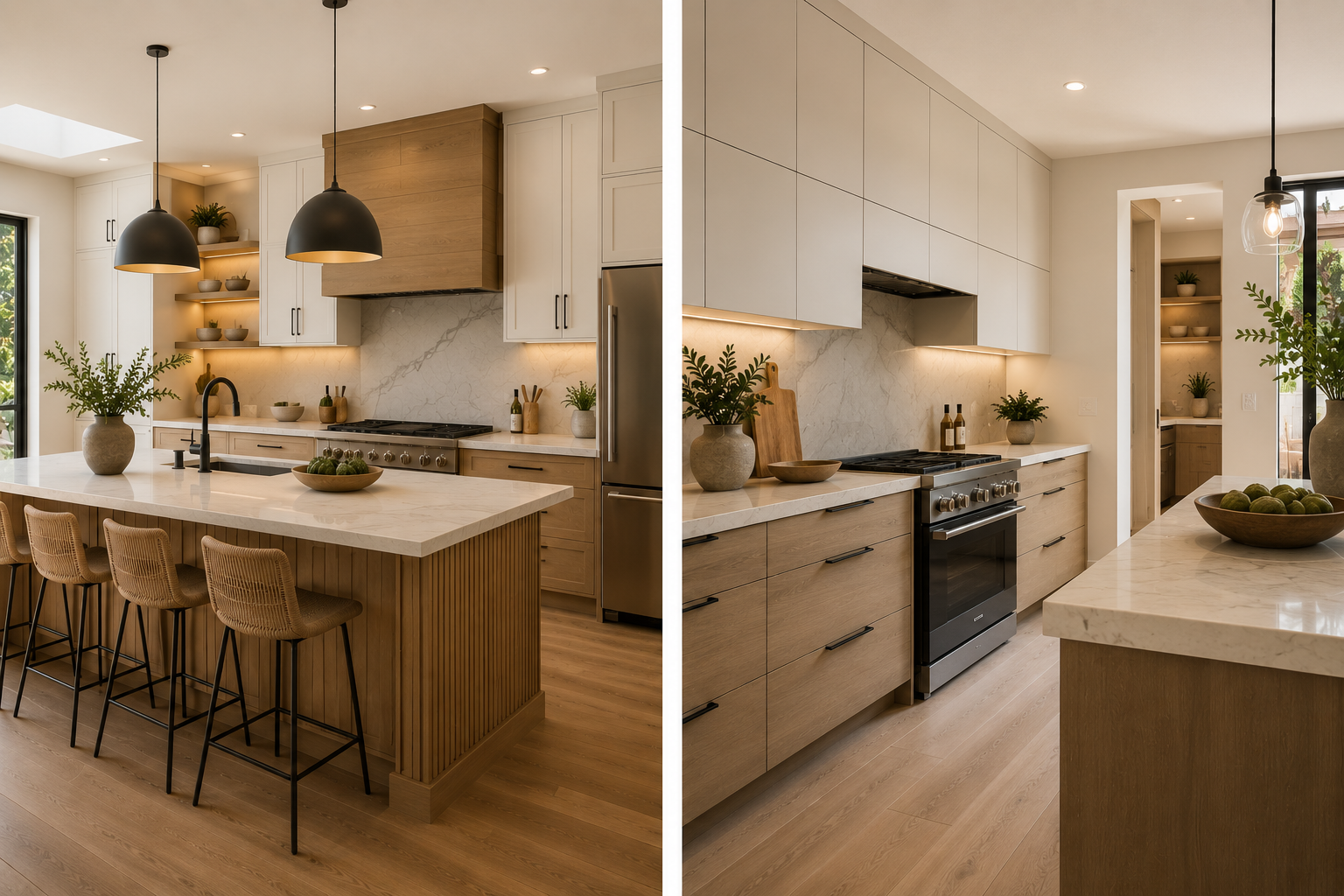
Two-tone cabinets (upper light / lower warm wood): White or off-white uppers paired with white oak or walnut lowers. The warm lower cabinet grounds the kitchen without making it heavy, and the contrast reads as intentional rather than dated. This combination photographs well — important for resale in a market where listing photos drive first impressions.
Slab-front (flat-panel) in mid-range kitchens: Shaker dominated LA kitchens for 15 years. Slab-front — a single flat door with no rail profile — is moving into mid-range budgets as semi-custom cabinet brands expand their offerings. It requires very flat installation (no forgiveness for wall imperfections) but looks cleaner in open-plan kitchens.
Warm wood tones overall: White oak and light walnut are replacing the gray-washed wood tones of 2019–2022. The shift is toward warm without being rustic: natural grain, matte finish, minimal color variation. Both species are available in semi-custom and custom lines, with prices roughly 20–35% higher than painted MDF equivalents.
What Lasts: Timeless Kitchen Cabinet Designs
Trends change in 8–12 year cycles; kitchens are typically replaced every 15–20 years. The safest design decisions are ones that were mainstream 10 years ago and will still look appropriate 10 years from now.
White or off-white shaker cabinets remain the single most resale-safe choice in the LA market. Buyers across every price point can visualize their style in a white shaker kitchen; they have a harder time picturing past a dark navy custom cabinet that reflects a specific taste. If resale is a primary concern, white shaker with quartz countertops is the reliable answer.
Cabinet door profile: the less ornate the profile, the longer it looks current. Raised-panel doors with heavy decorative moldings — popular in the early 2000s — now read as dated regardless of paint color. Shaker and slab profiles have remained in demand across multiple style cycles because they're compatible with both transitional and contemporary aesthetics.
Painted MDF vs wood: for painted cabinets, high-quality MDF with a factory-sprayed finish holds up better than site-painted solid wood. Factory finishes are harder and more uniform; site-painted wood grain telegraphs through the paint over time. If you're choosing wood tones (stained or natural), solid wood or plywood is preferred — MDF doesn't stain consistently.
Cabinet Material Comparison: Solid Wood vs MDF vs Plywood
|
Material |
Price range (full kitchen) |
Best for |
Drawback |
|---|---|---|---|
|
Solid wood |
$20,000–$50,000+ |
Stained/natural finishes, custom work |
More expensive; minor seasonal movement |
|
Plywood box + wood face |
$12,000–$30,000 |
Mid-range semi-custom; best durability-to-cost ratio |
Face frame style limits some door profiles |
|
MDF (painted) |
$6,000–$18,000 |
Factory-painted flat or shaker doors |
Not suitable for stained finishes; heavy |
|
Particleboard (stock) |
$3,000–$8,000 |
Budget remodels, rental units |
Lower durability; most susceptible to moisture |
For LA's climate — relatively dry with minimal humidity swings — solid wood and plywood perform comparably over time. The practical difference shows up in cost: plywood-box semi-custom cabinets give you most of the durability of solid wood at 30–40% lower cost.
Semi-Custom vs Custom vs Stock: What's the Right Choice for LA Homes?
Stock cabinets (IKEA, Home Depot): $3,000–$8,000 for a standard kitchen. Fixed sizes and limited finishes. Appropriate for rental properties and short-term holds. IKEA's SEKTION line with aftermarket fronts (Semihandmade, Reform) is a popular LA upgrade path — it delivers a semi-custom look at stock prices, though installation requires more planning.
Semi-custom cabinets: $10,000–$28,000. Standard sizes but flexible configurations, finish options, and storage upgrades (pull-outs, soft-close, drawer organizers). This tier represents the best value for primary-home remodels — enough flexibility to optimize the layout without the lead time and cost of full custom.
Custom cabinets: $25,000–$60,000+. Built to exact dimensions, any finish or material. The right choice for unusual layouts (angled walls, ceiling-height runs, window-seat integrations) or for primary residences where the homeowner is staying 10+ years. Lead time is typically 8–14 weeks; budget the project timeline accordingly.
Hardware Trends: How to Match Finish to Cabinet Style
Hardware finish is the fastest and cheapest way to update a kitchen — or to unintentionally date it. The general rule: pick one primary finish and stay consistent across pulls, knobs, faucet, and appliance handles.
Matte black: works best with white or off-white cabinets and contemporary profiles (shaker or slab). Creates strong visual contrast. Durability is good on powder-coated hardware; avoid thin PVD coatings that chip in high-use kitchens.
Brushed brass / unlacquered brass: the strongest 2024–2026 trend in LA kitchens. Pairs well with warm wood tones and two-tone white-oak-lower configurations. Unlacquered brass develops a patina over time — intentional in some aesthetics, not in others. Brushed brass maintains finish longer.
Brushed nickel / stainless: the safe transitional choice. Compatible with almost every cabinet style and finish. Lower visual impact than black or brass but virtually never dates badly. If resale is imminent, brushed nickel is the lowest-risk hardware choice.
What to avoid: mixing more than two finishes in the same kitchen (e.g., matte black pulls + brushed brass faucet + stainless appliances = visual noise), and high-gloss chrome on traditional-profile cabinets — it reads as builder-grade regardless of cabinet quality.
What to Avoid: Cabinet Choices That Age Poorly in LA
The title of this article makes a promise — so here it is specifically:
Very dark lowers with very dark uppers: two-tone only works when there's real contrast. Dark navy or forest green all-cabinet kitchens were popular in 2020–2022. They're beginning to polarize buyers at resale; some love them, a significant share need them repainted before they'll make an offer. If you love a dark kitchen, keep it to one surface (island, lowers only) and leave the uppers light.
Highly textured wood grain in faux finishes: printed woodgrain on thermofoil or laminate cabinet doors has improved, but at resale, buyers can identify it. In LA's mid-range market, buyers compare finishes closely. Faux-grain stock cabinets in an otherwise well-finished kitchen read as a shortcut.
Glass-front uppers in high-traffic family kitchens: glass fronts look compelling in photos and are genuinely beautiful in kitchens with organized interiors. In everyday use with kids or heavy cooking, they require constant organization and cleaning. Many homeowners who choose them switch back to solid doors within 3–5 years, which means paying for the change twice.
Extremely narrow pulls or bar handles on shaker profiles: bar handles suit slab-front doors cleanly. On shaker profiles, they create a visual mismatch — the traditional door profile conflicts with the industrial hardware. Shaker doors read better with small knobs, cup pulls, or integrated finger pulls.
Refinishing instead of replacing cabinets past 20 years: cabinet refinishing (spray-painting existing doors) works well for solid wood boxes in good structural condition. On older particleboard-box cabinets with delaminating interiors, deteriorating soft-close hardware, and sagging shelves, refinishing the exterior while leaving degraded structure is a short-term cosmetic fix that doesn't address the real issues and often delays a more cost-effective full replacement.
Budget Breakdown: Cabinets and the Rest of the Kitchen
For a mid-range LA kitchen remodel, a realistic budget allocation looks like this:
|
Line item |
% of total |
Typical range (mid-range remodel) |
|---|---|---|
|
Cabinets |
30–35% |
$13,000–$28,000 |
|
Labor (installation, carpentry) |
20–25% |
$9,000–$20,000 |
|
Countertops |
12–18% |
$6,000–$15,000 |
|
Appliances |
10–15% |
$5,000–$12,000 |
|
Flooring |
5–8% |
$3,000–$7,000 |
|
Plumbing / electrical |
5–10% |
$2,500–$8,000 |
|
Permits and inspections |
2–5% |
$1,000–$4,000 |
ROI at resale for a kitchen remodel in LA runs 65–75%, somewhat above the national average, according to Remodeling Magazine's annual Cost vs. Value data. Full custom kitchens in high-end homes tend to return less percentage-wise — buyers in those price brackets don't pay dollar-for-dollar for premium finishes they would have chosen differently themselves.
The Bottom Line
The most durable kitchen cabinet investment in LA in 2026 is also the most reliable at resale: white or off-white shaker in semi-custom plywood-box construction, paired with quartz countertops and one consistent hardware finish. If you have more budget and want to reflect current LA aesthetics, two-tone with warm oak lowers and an integrated slab-front island is the direction that looks current without betting on a single trend. What to avoid is clear: dark all-over finishes on a budget, faux-grain thermofoil in mid-range homes, and refinishing structurally compromised cabinets. IA Remodelings works with LA homeowners through the full cabinet decision — material selection, layout optimization, and LADBS permitting for scope changes — connecting you with vetted contractors who provide written quotes broken out by line item so you know exactly what you're paying for.
Want a specific estimate for your kitchen in Los Angeles?
Tell our agent about your project — it'll match you with a verified local pro in minutes.
Comments