
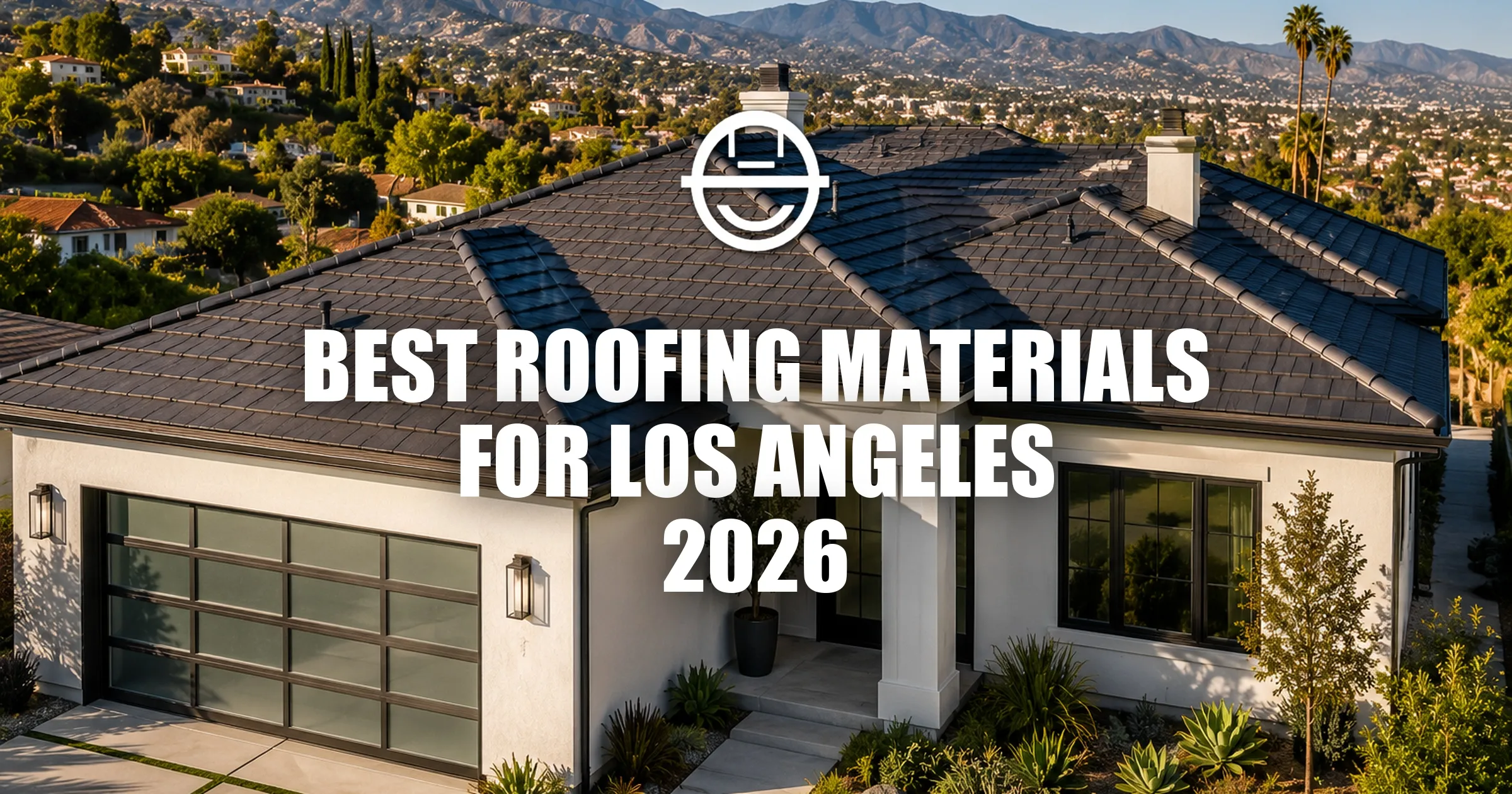
Best Roofing Materials for Los Angeles Homes in 2026: Fire-Rated, Cool Roofs, and What Actually Lasts in SoCal
Choosing a roof in Los Angeles means navigating three overlapping requirements that don't exist in most other US markets: mandatory fire ratings in WUI zones, California's Title 24 cool roof standards, and a climate that combines intense UV, coastal salt air, and near-zero annual rainfall — each of which affects how long a material actually lasts.
At a Glance: Roofing in LA 2026
|
|
|
|---|---|
|
Average cost |
$7,500 – $60,000 |
|
Cost per sq ft |
$4.50 – $25 |
|
ROI at resale |
60–70% |
|
Typical timeline |
1–5 days |
|
Permit required |
Yes |
|
Local market factor |
~1.35x national baseline |
Quick benchmark: A mid-range architectural shingle roof on a 1,500–2,000 sq ft LA home typically costs $12,000–$22,000 installed, including permit and tear-off.
How Much Does a Roof Cost in Los Angeles in 2026?
Roofing costs in Los Angeles run approximately 35% above the national average due to labor rates, permit fees, and the structural inspections required for tile roofs in a seismic zone.
|
Material |
Cost per Sq Ft (installed) |
Total Cost (1,500–2,000 sq ft) |
Lifespan |
|---|---|---|---|
|
Asphalt shingles (3-tab) |
$4.50 – $7.00 |
$7,500 – $14,000 |
15–20 years |
|
Architectural shingles |
$6.00 – $10.00 |
$10,000 – $20,000 |
25–30 years |
|
Metal roof (standing seam) |
$10.00 – $18.00 |
$20,000 – $50,000 |
40–70 years |
|
Concrete tile |
$12.00 – $20.00 |
$25,000 – $50,000 |
40–50 years |
|
Clay tile |
$15.00 – $25.00 |
$30,000 – $60,000 |
50+ years |
|
Modified bitumen/TPO (flat) |
$5.00 – $9.00 |
$8,000 – $22,000 |
15–25 years |
Permit costs from LADBS add $300–$1,500 for most residential re-roofs, with additional fees for structural work required by heavier tile systems.
Material-by-Material Assessment for LA Conditions
Not all roofing materials perform the same way in SoCal's specific combination of UV intensity, near-zero rain, coastal salt exposure, and wildfire risk. Here's how each option holds up:
|
Material |
Fire rating |
Title 24 cool roof |
SoCal durability |
Best LA application |
|---|---|---|---|---|
|
3-tab asphalt shingles |
Class A (most) |
Requires cool-roof product |
Fair — UV degrades granules faster in SoCal |
Budget re-roofs, flat lots, short ownership horizon |
|
Architectural shingles |
Class A |
Cool-roof versions available |
Good — heavier mat resists UV better than 3-tab |
Most mid-range LA homes, non-WUI zones |
|
Metal (standing seam) |
Class A |
Naturally compliant (high SRI) |
Excellent — handles UV, won't absorb embers |
Hillside homes, modern flat-roof designs, long-term ownership |
|
Concrete tile |
Class A |
Requires cool-roof coating |
Excellent — doesn't degrade from UV or heat |
Spanish/Mediterranean-style homes, most of the region |
|
Clay tile |
Class A |
Naturally compliant in most colors |
Excellent — 50+ year track record in SoCal |
Historic neighborhoods, higher-end homes |
|
Modified bitumen/TPO |
Class A or B |
Cool-roof TPO compliant |
Good for flat roofs — seams are the vulnerability |
Flat or low-slope roofs, ADUs, commercial-style residential |
Fire Zone Requirements: What LA Homeowners Must Know
Los Angeles County has an extensive Wildland-Urban Interface (WUI) zone — hillside communities from Malibu to the Verdugo Mountains to the San Gabriel foothills all fall under elevated fire risk classification. In these areas, roofing requirements are stricter than standard building code.
What the WUI zone means for your roof:
- Class A fire rating is mandatory in Very High Fire Hazard Severity Zones (VHFHSZ) designated by CAL FIRE
- The rating must apply to the full roofing assembly, not just the material itself — a Class A shingle on a wood deck without a fire-resistant underlayment may not meet the assembly requirement
- Ember resistance matters as much as direct flame resistance: most WUI homes ignite from ember accumulation in valleys, gutters, and vents, not from flame contact
Insurance implications: Homes in VHFHSZ with Class A roofs typically qualify for lower fire insurance premiums than Class B or C equivalents. Given that LA homeowners' insurance costs have risen significantly in recent years, a Class A roof assembly is increasingly a financial decision, not just a code compliance one. Verify your specific zone at LADBS before selecting a material.
Materials that naturally meet WUI requirements: Metal (standing seam), concrete tile, and clay tile are the most defensible choices in WUI zones because they don't absorb or spread embers and don't require additional assembly components to achieve Class A rating.
Cool Roof Requirements in California
California's Title 24 Energy Code requires cool roof compliance on re-roofs, meaning the new roofing material must meet minimum Solar Reflectance Index (SRI) values. The requirement varies by roof slope:
- Low-slope roofs (≤2:12 pitch): Minimum SRI of 0.78 — TPO and white-coated membranes meet this naturally
- Steep-slope roofs (>2:12 pitch): Minimum aged solar reflectance of 0.20 — most architectural shingles now offer compliant "cool roof" product lines
The ENERGY STAR Roof Products program certifies materials that meet or exceed these reflectance thresholds. When requesting quotes, ask contractors to confirm the CRRC (Cool Roof Rating Council) ratings of the specific product they're proposing — not just the manufacturer's marketing language.
Which materials are naturally compliant: Light-colored clay and concrete tile, unpainted Galvalume or aluminum metal roofing, and white/light-gray architectural shingles with ENERGY STAR certification. Dark asphalt shingles require a specifically rated "cool roof" product line to pass Title 24.
What Actually Lasts in SoCal: The Climate Reality
The SoCal climate is often described as ideal — mild temperatures, low rain, abundant sun. For roofing materials, "abundant sun" and "low rain" translate into specific durability patterns that differ from what national contractor averages assume:
UV intensity accelerates asphalt degradation. Los Angeles receives significantly more UV radiation than the national average used to calculate typical shingle lifespans. A 3-tab shingle rated for 20 years in the Midwest may reach end of life in 12–15 years in the San Fernando Valley or Inland Empire due to granule loss and mat degradation. Architectural shingles hold up better because of the heavier asphalt mat.
Coastal salt air affects metals differently. Within 1–3 miles of the ocean (Santa Monica, Malibu, Long Beach), standard Galvalume steel develops corrosion over time. Coastal installations should use aluminum or a factory-painted steel with a PVDF coating, not bare Galvalume. Clay and concrete tile are immune to salt air and are the dominant material in coastal LA neighborhoods for this reason.
Minimal rain doesn't mean waterproofing doesn't matter. LA receives 14–15 inches of rain annually — mostly in January and February, sometimes in intense bursts during El Niño years. Flat or low-slope roofs are particularly vulnerable to improper drainage: water that pools and can't drain will find any seam or fastener. Seam and flashing quality matter more in LA than raw material choice.
Thermal cycling in inland valleys. The San Fernando Valley and San Gabriel Valley experience 40–50°F temperature swings between day and night in summer. Materials that expand and contract repeatedly (metal, thermoplastic membranes) need proper installation allowances for thermal movement — a cheap installation that skips thermal expansion details will fail at fasteners within 5–10 years.
How to Choose by Neighborhood Type
|
Neighborhood type |
Primary concern |
Top material choices |
What to avoid |
|---|---|---|---|
|
Hillside / WUI zone |
Fire + ember resistance |
Standing seam metal, concrete tile, clay tile |
Wood shake (prohibited), standard asphalt without Class A assembly |
|
Coastal (Malibu, SM, LB) |
Salt air + cool roof compliance |
Clay tile, aluminum metal, PVDF-coated steel |
Standard Galvalume steel without coating |
|
Inland valley (SFV, SGV) |
UV durability + heat |
Concrete tile, standing seam metal, cool-roof architectural shingles |
3-tab asphalt (shortest lifespan in high-UV environment) |
|
Urban flatland (mid-city, east LA) |
Budget + cool roof + permit speed |
Architectural shingles (cool-roof line), TPO for flat |
Non-compliant products that will fail Title 24 inspection |
HOA Rules in LA
Many HOAs in gated communities, hillside neighborhoods, and master-planned developments have CC&Rs that specify approved roofing materials, colors, or profiles. Common restrictions include requiring concrete or clay tile to match the community aesthetic, prohibiting unpainted metal, and limiting color ranges.
Before ordering materials, check your HOA's CC&Rs or submit for architectural approval. A material that passes LADBS permit review can still be rejected by an HOA — and reordering materials after tear-off is expensive.
The Bottom Line
For most Los Angeles homeowners, the decision comes down to three variables: whether you're in a WUI fire zone (if yes, eliminate anything below Class A assembly), how long you plan to own the home (if under 10 years, architectural shingles; over 20 years, tile or metal), and whether you're in a coastal microclimate (if yes, avoid standard Galvalume).
The NAHB Remodeling Market Index consistently shows roofing among the highest-ROI exterior projects — 60–70% cost recovery at resale — and in a fire-risk market like LA, a compliant Class A roof also protects your insurability.
IA Remodelings connects Los Angeles homeowners with licensed roofing contractors who provide written quotes itemizing material, labor, permit, tear-off, and underlayment — and who can confirm fire zone compliance and Title 24 cool roof certification for the specific product before you sign.
Want a specific estimate for your roof in Los Angeles?
Tell our agent about your project — it'll match you with a verified local pro in minutes.
Comments