
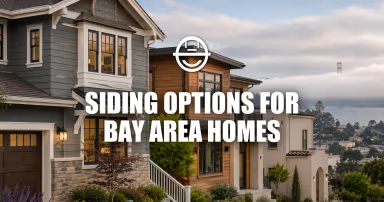
Siding Options for Bay Area Homes: What Handles the Climate and What the Costs Look Like in 2026
Bay Area siding decisions carry two constraints that most national cost guides don't account for: the region's combination of coastal fog, salt air, and seismic activity genuinely narrows which materials perform well long-term, and the Very High Fire Hazard Severity Zone (VHFHSZ) designations that cover most of the Bay Area's hillside communities legally restrict which materials are allowed at all. Choosing the wrong material here doesn't just mean more maintenance — it can mean a permit rejection or an insurance complication.
At a Glance: Siding in the Bay Area 2026
|
|
|
|---|---|
|
Average cost |
$10,000 – $40,000 |
|
Cost per sq ft installed |
$5 – $18 |
|
ROI at resale |
70–85% |
|
Typical installation timeline |
3–10 days |
|
Permit required |
Yes for full replacement; check for re-coat/repair |
|
Local market factor |
~1.40x national baseline |
How Much Does Siding Cost in the Bay Area in 2026?
Labor costs in the Bay Area run approximately 1.40x the national baseline, which pushes installed siding costs well above national averages for every material category.
|
Material |
Installed cost (avg Bay Area home) |
Cost per sq ft |
Lifespan |
Fire rating |
|---|---|---|---|---|
|
Vinyl |
$9,000 – $20,000 |
$4 – $8 |
20–30 years |
Not Class A — restricted in VHFHSZ |
|
Fiber cement (HardiePlank) |
$15,000 – $30,000 |
$7 – $14 |
30–50 years |
Class A — approved in fire zones |
|
Engineered wood (LP SmartSide) |
$13,000 – $26,000 |
$6 – $12 |
25–35 years |
Class A available (ExpertFinish line) |
|
Natural wood (cedar/redwood) |
$18,000 – $40,000 |
$9 – $18 |
15–30 years* |
Not Class A unless fire-treated |
|
Stucco (new application) |
$11,000 – $27,000 |
$5 – $12 |
50+ years |
Class A |
*Natural wood lifespan with proper 3–5 year maintenance cycles; without maintenance in fog zones, deterioration begins in 7–10 years.
Get Your Free Siding Estimate →
Bay Area Climate Stressors: What Each Material Actually Faces
The Bay Area's climate is not uniform. Material performance depends heavily on which microclimate zone a property sits in — and the VHFHSZ designation is a hard constraint that overrides material preference entirely.
Coastal fog moisture: neighborhoods from San Francisco through Daly City, Half Moon Bay, and parts of the East Bay near the water experience extended periods of damp exterior surfaces from fog cycling. Materials that absorb moisture — untreated natural wood, some fiber cement products with compromised factory finish — develop moss, mildew, and accelerated deterioration. Fiber cement with a factory-applied prefinished coating handles fog-zone moisture significantly better than field-painted installations.
Salt air corrosion: properties within 1–2 miles of the bay or ocean face accelerated corrosion on metal fasteners, flashing, and trim. This affects all siding systems through their attachment hardware, not the cladding material itself. In salt-air zones, stainless steel or hot-dipped galvanized fasteners are required — standard zinc-coated fasteners corrode within 5–10 years, creating rust staining on the siding surface and eventual structural attachment failure.
Temperature swings and caulk failure: the Bay Area's microclimates create unusual daily temperature variation — a home in Walnut Creek can swing 40°F in a single day during certain seasons. That thermal cycling degrades caulk and sealant at penetrations, corners, and trim joints faster than in stable-climate markets. Plan for caulk inspection and reapplication every 5–7 years regardless of siding material, or use fiber cement with factory-caulked joints where possible.
VHFHSZ fire requirements — the constraint most homeowners miss: CAL FIRE designates most of the Bay Area's hillside communities — Oakland Hills, Orinda, Moraga, Marin County, parts of Santa Clara County, and significant portions of the Peninsula — as Very High Fire Hazard Severity Zones. In those zones, California Building Code requires Class A exterior cladding. Vinyl siding is not Class A rated and cannot legally be installed in VHFHSZ-designated properties. Fiber cement, stucco, and EIFS systems are Class A by default. Engineered wood is Class A only in specific product lines (LP SmartSide ExpertFinish). Verify your property's fire zone status before selecting a material at osfm.fire.ca.gov
Seismic movement and stucco: traditional three-coat stucco is prone to cracking from Bay Area seismic activity. Hairline cracks are mostly cosmetic but must be sealed promptly — unsealed cracks in fog-zone properties allow moisture intrusion that accelerates deterioration behind the surface. Elastomeric coatings applied over existing stucco flex with the structure and seal minor cracking. EIFS (Exterior Insulation and Finish Systems) is more seismically resilient than traditional hard-coat stucco but requires a contractor experienced in proper installation to avoid moisture trapping.

Material-by-Material Performance for Bay Area Conditions
Fiber cement (HardiePlank, James Hardie) is the highest-performing option for most Bay Area properties. It is Class A fire rated, dimensionally stable under thermal cycling, does not absorb moisture, and resists the moss and algae growth that fog-zone humidity promotes. The installation cost premium over vinyl is recovered in lower maintenance over a 15–20 year period. Metal fasteners must be stainless or hot-dipped galvanized in coastal zones. Repainting is required every 10–15 years; factory pre-finished products extend that cycle and perform better in direct coastal exposure.
Vinyl is appropriate for non-fire-zone, non-coastal Bay Area neighborhoods — inland East Bay, South Bay flatlands, and similar locations without VHFHSZ designation or significant salt-air exposure. In those locations it offers the lowest maintenance cost and a serviceable lifespan. It cannot be used on properties in designated fire hazard zones, and some vinyl formulations develop brittleness and color fade in high-moisture environments over time. If your property is on a hillside or in a community that experienced wildfire risk in the last 20 years, verify fire zone status before specifying vinyl.
Engineered wood (LP SmartSide) bridges the gap between fiber cement and natural wood: it provides the look of natural wood grain with significantly better moisture resistance, and the ExpertFinish product line carries a Class A fire rating. It requires repainting every 5–8 years in fog-zone applications — a shorter cycle than fiber cement in wet climates. A good choice for homes where wood aesthetics are important but natural wood's maintenance demands in coastal conditions are not acceptable.
Natural wood (cedar, redwood) makes sense primarily for period-appropriate restorations — Victorian, Craftsman, and Edwardian-era Bay Area homes where matching original materials is architecturally and historically important. In those applications the maintenance cost (staining and sealing every 3–5 years in coastal areas) is a known expense, not a surprise. For modern installations, the same aesthetic is achievable with lower long-term maintenance cost using engineered wood or fiber cement with a wood-grain finish profile.
Stucco remains the dominant exterior cladding on Bay Area Spanish Colonial, Mediterranean, and Ranch-style homes. Class A fire rated and thermally efficient, it is appropriate for fire-zone properties and well-suited to the region's style vernacular. The key maintenance requirement is prompt sealing of any cracks — in the Bay Area's seismically active environment, cracks should be inspected annually and sealed with elastomeric caulk. Full re-coating with elastomeric paint every 15–20 years extends the system's life and improves weather resistance.
Permit and HOA Requirements
Building permits are required for full siding installation replacements in all Bay Area jurisdictions. Re-coating stucco or repainting does not require a permit; replacing the cladding material or adding a new layer over existing siding does. In VHFHSZ zones, the fire department review confirms material compliance with Class A requirements as part of the permit inspection. For San Francisco projects, permit applications go through SF Planning for properties in certain overlay districts.
HOA review applies to nearly all exterior material or color changes in HOA-governed communities. Most Bay Area HOA review periods run 30–60 days, and approval requires submitting material specifications and color samples. Submit to the HOA at the same time as the permit application — processing them sequentially rather than in parallel is the most common avoidable source of project delays.
Historic districts: parts of San Francisco, Oakland, and some Peninsula cities have historic preservation overlay districts that restrict exterior material changes — specifically, replacing original wood siding with fiber cement requires documentation that the visual profile matches the original. Confirm with your local planning department before finalizing a material selection in a historically designated neighborhood.
The Bottom Line
For Bay Area homeowners, fiber cement is the strongest all-around choice for hillside, coastal, and fire-zone properties — it meets Class A requirements, handles fog moisture without deterioration, and carries a 30–50 year lifespan with manageable maintenance. Vinyl is appropriate only for non-fire-zone, non-coastal locations, and the VHFHSZ map covers more of the Bay Area than most homeowners realize before starting a project. Stucco and engineered wood are strong alternatives depending on architectural style and fire zone status. IA Remodelings connects Bay Area homeowners with licensed siding contractors who verify fire zone compliance before quoting materials, use the correct fastener spec for coastal zones, and pull building permits with fire department review included — so the installation passes inspection on the first attempt.
Want a specific estimate for your siding in Bay Area?
Tell our agent about your project — it'll match you with a verified local pro in minutes.
Comments